
What to Prepare Before the First Call With a Private Label Perfume Supplier
A first call with a private label perfume supplier usually fails for a boring reason: the brand has not decided what it is buying. Deciding between a library scent and a developed one, naming a fill size and a target price, and knowing which market the product will be sold in takes an afternoon of internal work, and it changes the entire conversation. Arrive with those three settled and the first call becomes a scoping session rather than a polite introduction.
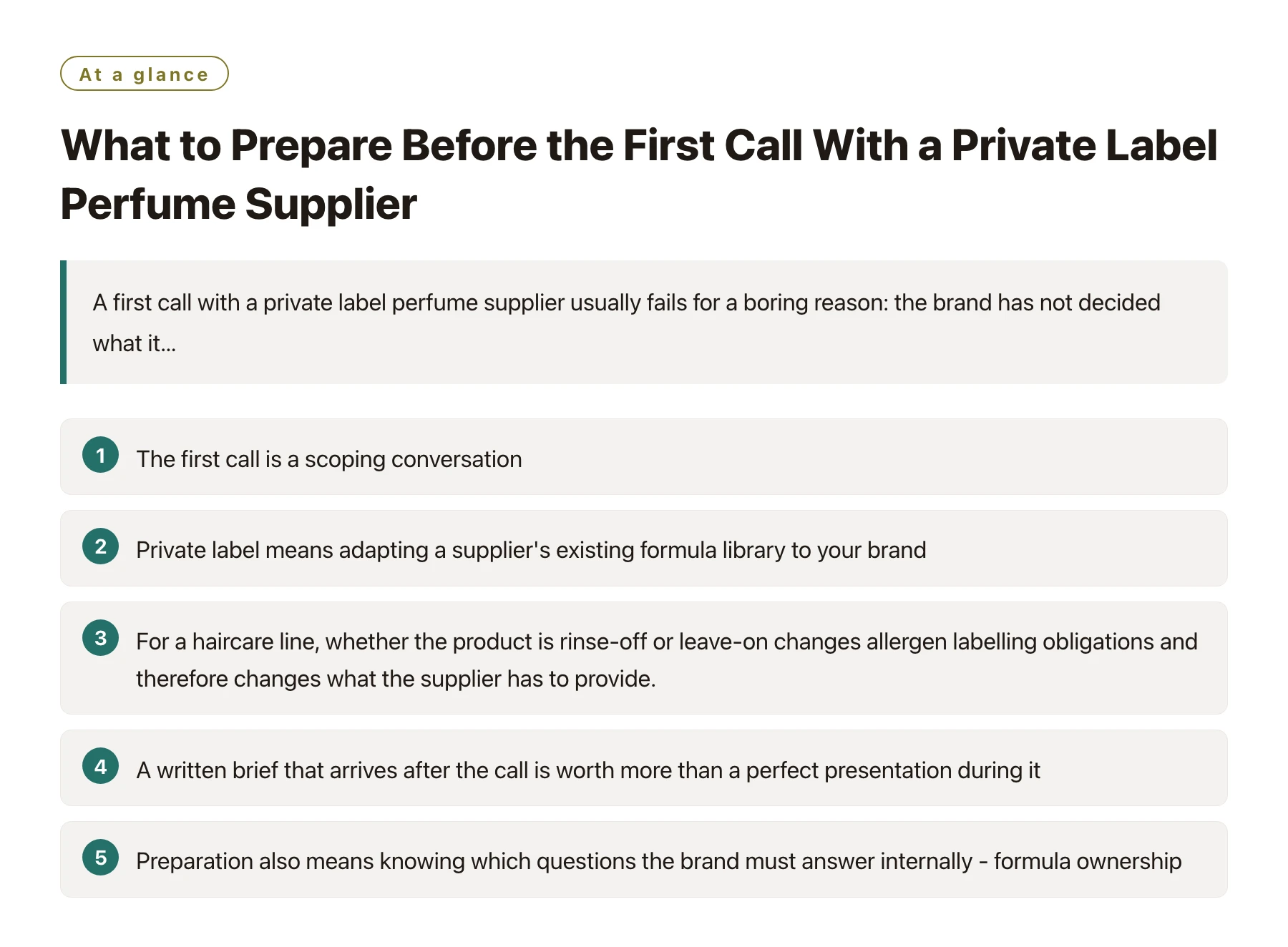
Key takeawaysThe first call is a scoping conversation, so the brand needs a decided product concept, a target unit cost and a launch market before it happens. · Private label means adapting a supplier's existing formula library to your brand, which makes library depth and adaptation limits the two things worth probing first. · For a haircare line, whether the product is rinse-off or leave-on changes allergen labelling obligations and therefore changes what the supplier has to provide. · A written brief that arrives after the call is worth more than a perfect presentation during it, because it can be quoted and compared line by line. · Preparation also means knowing which questions the brand must answer internally - formula ownership, exclusivity and claim wording - before a supplier can be judged.
Supplier calls tend to be scheduled too early. A brand team decides it needs a perfume in its haircare range, asks three manufacturers for an introduction call, and spends forty minutes describing the product to each of them in slightly different words. Nothing is decided, and the quotes that follow are not comparable.
The fix is preparation, and it is not complicated. Private label work is faster than custom development precisely because fewer decisions are open; the brand's job in the first conversation is to close some of them rather than open more.
This guide sets out what to settle internally before the call, what to hold back for the written brief, and which parts of the preparation change when the product is a shampoo or a leave-in treatment rather than a bottle of eau de parfum.
Why the first call produces so little
Manufacturers cannot quote a private label programme from a description. They need a fill size, a target cost, an order quantity and a market, because each one of those pulls the answer in a different direction. Without them, the supplier can only describe its general capability, which is exactly what its website already does.
The brand side has the same problem in reverse. Without a decided concept, every supplier looks plausible, and the differences that matter - library depth, fill capacity, decoration options, documentation - are invisible because nothing has been asked that would expose them.
What a scoping call can and cannot do
A good scoping call can establish whether the supplier's library has anything close to your concept, what its minimum order quantity is for your format, what documentation it provides as standard, and how it handles artwork and packaging. It cannot produce a price. Treating the call as a price conversation wastes the part of the meeting that is actually informative.
The one decision that changes everything
Deciding between a library scent and a developed one is the fork that shapes the whole project. A library scent is faster, cheaper and less exclusive; a developed scent costs more and takes longer but can be owned or held exclusively. Settling that internally before the call means the supplier can steer the conversation to the right half of its own capability.
Seven things to have ready before the call
| What to prepare | Why the supplier needs it | What it changes in the call |
|---|---|---|
| Product concept and format | Rinse-off or leave-on, spray or pump, and the size of the pack all constrain the formula | Moves the discussion from capability to a specific development route |
| Target unit cost | Fragrance load and packaging are the two biggest cost levers, and both follow the price ceiling | Lets the supplier say what is achievable instead of listing options |
| Launch market and channel | Labelling rules, allergen declaration and claim wording differ by market | Surfaces documentation questions early, before they become shipping delays |
| First-run quantity and a realistic growth case | Minimum order quantity applies per component, not just per formula | Turns a vague minimum into a specific quote for your pack |
| Library or developed scent | Determines exclusivity, lead time and how much development cost sits in the project | Focuses the call on either library sampling or a development brief |
| Who owns the brand and the formula | Ownership and exclusivity terms are decided by the brand, not by the supplier | Prevents a later disagreement about rights to the formula |
| Internal decision-maker and timeline | Suppliers prioritise programmes with a named owner and a date | Signals whether this is a real project or early research |
None of these requires specialist knowledge. They require one internal meeting and one page of notes. The brands that arrive at a first call with this page tend to leave with a next step; the ones that arrive without it leave with a brochure.
What belongs on the call and what belongs in the brief
The call is for fit; the brief is for detail. Mixing the two is how brands end up with a supplier that talked well and quoted badly.
Fit questions are the ones a supplier answers in a sentence and cannot easily fake: which product categories it actually fills, whether it has a library in your category, what its standard documentation pack contains, and who would manage your project day to day. These are the questions to spend the call on.
Fit questions: short answers, hard to fake
Ask what share of the supplier's work is in your product category, and ask it as a question about process rather than prestige. A manufacturer that mostly fills fine fragrance will describe a different sample round, a different fill line and a different documentation habit from one that fills rinse-off personal care in high volumes. For a haircare line, that difference is not cosmetic.
Brief questions: write them down, send them after
Volume, fill size, decoration, allergen expectations, artwork deadlines and packaging sourcing all belong in a written brief sent after the call. Written material can be quoted, compared between suppliers and amended without another meeting. The act of writing it also exposes the decisions the brand has not made yet, which is exactly why doing it before shortlisting a private label partner saves weeks choosing a private label perfume partner.
Documentation questions to raise early
Ask which safety and compliance documents come as standard and which are charged separately. Ingredient safety assessment, allergen declaration and stability documentation are the usual three, and the answers differ between suppliers and markets. European rules on cosmetic product safety assessment are a reasonable reference point for what a serious supplier should be able to discuss [1]. The fragrance materials themselves are also governed by industry use standards that restrict how much of a given material may go into a product category, so a supplier should be able to say which materials in a proposed formula carry those restrictions [2].
The haircare wrinkle is rinse-off versus leave-on. A shampoo that carries fragrance and is rinsed away is treated differently from a leave-in serum that stays on the scalp, and the difference shows up in allergen declaration and in how much fragrance load the formula can reasonably carry. If the same scent is going into both a shampoo and a leave-in treatment, the brand should say so in the first call, because the supplier may recommend one formula for both or two separate versions. Discovering this after the brief is written means the sampling round is repeated, and that cost sits with the brand, not the supplier.
Reading a supplier's answers without being impressed by them
Once the preparation is done, the call becomes a comparison exercise. The most useful signal is not enthusiasm but specificity: a supplier that names a process, a document and a person is describing how it works, while one that talks only in adjectives is describing how it would like to be seen.
Scale helps here, but it needs to be read carefully. A manufacturer that works with many brands across many countries will have a well-worn process for private label adaptation, and its public figures are worth asking about rather than assuming - Xuelei, for instance, publishes that it serves hundreds of brands across more than a hundred countries, which is a company statement rather than an audited number. What matters for the call is what such scale means for your project: a deeper library and more standard documentation, but also a queue you have to fit into.
If the supplier also works as a private label partner for perfume lines across home and body categories, ask how it keeps those lines separate - different fill lines, different documentation templates, or the same process for everything a private label partner for perfume lines. The answer tells you whether your haircare project is routine work or an exception.
Ask for a comparable reference, not a favourite one
Suppliers will offer their proudest project. Ask instead for a programme of similar size and format to yours, and ask what went wrong in it. Examples of fragrance projects are more useful when they include the constraints: a small first run, a tight artwork deadline, a market with strict labelling. Case material is most informative where it is least glossy the brands behind these scents.
Decide what you will not negotiate
Before the call, write down the two or three terms that are not flexible - an ownership clause, a launch date, a cost ceiling. Suppliers negotiate against whatever is softest, and a brand that has not decided which term is hard will find that all of them bend.
Sources
- European Commission: Cosmetic Products — Specific Topics —— EU pages covering specific cosmetics topics such as product claims, nanomaterials and animal-testing rules.
- IFRA Standards Library (International Fragrance Association) —— The IFRA Standards Library lists the restrictions the fragrance industry applies to individual fragrance ingredients, based on safety assessments; it is the reference point for compliant fragrance formulation.
Frequently asked questions
How long should a first call with a perfume supplier take?
Thirty to forty-five minutes is usually enough if the brand has prepared. Longer calls tend to mean the concept is still open, and the supplier is filling the time with capability description. If you need more than an hour, split it: one call on fit and documentation, one on the brief.
Should I send the brief before or after the first call?
After. The call is for checking fit and for asking the questions a brief cannot answer, such as who manages the project and what documentation is standard. Send the written brief once you have a shortlist, so the same document goes to every supplier and the quotes can be compared line by line.
Does a haircare line need a different private label approach from a perfume line?
Partly. The main differences are the substrate the fragrance sits in and whether the product is rinsed off. Both affect fragrance load, stability testing and allergen declaration. The private label model is the same, but the questions about formula adaptation and documentation are more specific.
What if the supplier's minimum order quantity is higher than my first run?
Ask which component sets the minimum. It is often the bottle or the cap rather than the fragrance, and component minimums can sometimes be met by choosing a standard pack for the first run and a custom one later. If the minimum still does not fit, that is useful information before the brief rather than after.
How do I judge library depth on one call?
Ask for a shortlist of library scents in your category within a few days of the call, with the option to order samples. A supplier with real depth can produce candidates quickly; one without it will offer to develop something from scratch, which is a different and slower project.